

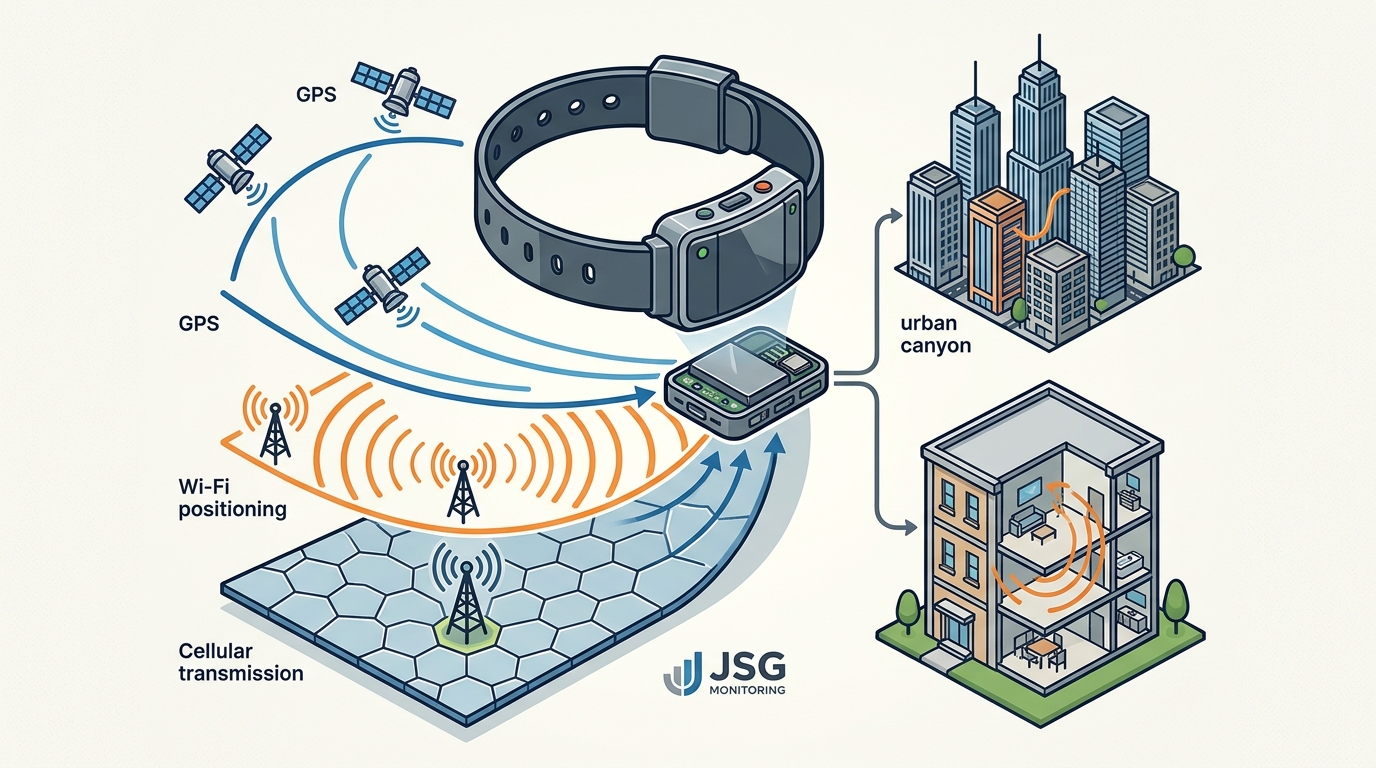
Modern ankle monitors rely on a multi-layered connectivity stack combining GPS, Wi-Fi, and cellular data to ensure precise location tracking. This redundancy allows devices to maintain accuracy even in urban canyons or indoor environments where satellite signals degrade. JSG Monitoring integrates these advanced technologies into low-profile hardware designed for long-term reliability and seamless data transmission.
Multi-Source Connectivity for Continuous Coverage
Reliable tracking requires more than a single signal source. GPS provides global coverage but struggles in dense urban areas or indoors. To solve this, modern devices use Wi-Fi and cellular networks as primary or fallback data pipes. This approach ensures that the device can report its location even when satellite visibility is blocked.
The BI LOC8 XT, for example, leverages GPS, Wi-Fi, and cellular technology to provide complete community coverage. By triangulating data from multiple sources, the system maintains accurate location tracking even during GPS interference. This redundancy is critical for preventing data gaps that could compromise supervision efforts.
Industry analysts are labeling the current era as the pivot to Generation 4 electronic monitoring, where hardware treats LTE as a fallback rather than the only pipe. This shift toward diversified connectivity stacks ensures that monitoring remains consistent regardless of the wearer's environment.
Precision Standards and Indoor Verification
Accuracy is defined by how closely the reported location matches the actual physical position. The National Institute of Justice Standard 1004.00 specifies a minimum accuracy of 10 meters in open-sky outdoor conditions and 30 meters in challenging environments. Meeting these thresholds is essential for valid zone management and curfew enforcement.
Indoor verification presents a unique challenge. GPS signals often fail inside buildings, leading to inaccurate location data. To address this, devices like the Omnilink GPS use optional RF and Wi-Fi Beacons to enable precise tracking in indoor and GPS-impaired environments. These beacons confirm presence at a specific location, such as a home, without relying solely on satellite data.
Next-generation ankle monitors solve this through WiFi-directed connectivity and BLE pairing with home beacons that confirm presence without GPS. This technology allows agencies to verify compliance with home curfews accurately, reducing false alerts and administrative burden.
Tamper Detection and Hardware Integrity
Reliability is not just about location data; it is also about ensuring the device remains intact. Tamper detection is a core feature that alerts monitoring centers when a device is removed or damaged. Modern systems use binary optical integrity checks to detect strap cuts or removal attempts.
The SCRAM GPS features a revolutionary tamper-proof strap that significantly reduces false alerts. This design ensures quick and reliable detection of potential tampering while minimizing unnecessary notifications. Similarly, the Omnilink GPS uses a cut-free, fiber optic strap to prevent false tamper alerts, reducing administrative burdens for monitoring staff.
Effective tamper detection requires a balance between sensitivity and reliability. Systems must be sensitive enough to detect genuine removal attempts but robust enough to ignore minor impacts or vibrations. This balance is achieved through advanced sensor fusion and algorithmic analysis of the data stream.
Power Management and Battery Life
Long battery life is a critical factor in device reliability. Frequent charging requirements can lead to non-compliance and data gaps. Modern ankle monitors are designed with power-saving features that extend battery life without sacrificing tracking frequency.
The BI LOC8 XT includes a power-saving beacon option that enhances battery life, ensuring reliable performance while minimizing the need for frequent recharges. The BI VeriWatch, a wrist-worn alternative, offers up to 16 hours of battery life on a single charge and up to 24 hours when paired with a portable transfer battery. These specifications allow for flexible charging schedules that fit the wearer's routine.
Efficient power management also involves optimizing data transmission. Devices can adjust their reporting frequency based on movement and location context, conserving battery when stationary and increasing precision when moving. This adaptive approach ensures that the device remains operational for extended periods.
Software Integration and Data Visualization
Hardware capabilities are only as useful as the software that processes the data. Modern monitoring platforms integrate device data with mapping tools and analytics to provide actionable insights. This integration allows officers to visualize offender movements in real time and identify patterns that may indicate non-compliance.
The SCRAM GPS integrates with the SCRAM Systems platform, offering seamless connectivity through 3G technology. The inclusion of GPS Analytics and Google Street View mapping provides detailed insights into client movements, putting their locations into a clear, actionable context. These tools allow officers to interpret data efficiently, saving time and improving decision-making processes.
Software integration also supports automated reporting and alert management. By consolidating data from multiple devices and sources, platforms can generate clear, consistent reports that support judicial decision-making. This clarity is essential for maintaining the integrity of monitoring programs and ensuring that violations are addressed appropriately.
Key Takeaways
- Multi-source connectivity using GPS, Wi-Fi, and cellular data ensures continuous tracking in diverse environments.
- Indoor verification relies on RF and Wi-Fi beacons to confirm presence when GPS signals are unavailable.
- Tamper detection systems use optical integrity checks to distinguish between genuine removal and false alerts.
- Power-saving features and adaptive data transmission extend battery life, reducing the need for frequent charging.
- Software integration with mapping and analytics tools provides actionable insights for monitoring officers.
- Compliance with NIJ Standard 1004.00 ensures that devices meet minimum accuracy thresholds for reliable supervision.
Frequently Asked Questions
How do ankle monitors track location indoors?
Indoor tracking uses Wi-Fi and RF beacons to confirm presence at specific locations. These beacons communicate with the device to verify that the wearer is within a designated zone, such as a home, even when GPS signals are blocked.
What is the standard for ankle monitor accuracy?
The National Institute of Justice Standard 1004.00 specifies a minimum accuracy of 10 meters in open-sky conditions and 30 meters in challenging environments. This standard ensures that devices provide reliable location data for supervision purposes.
How does tamper detection work in modern devices?
Modern devices use optical sensors and binary integrity checks to detect strap cuts or removal. These systems are designed to minimize false alerts while ensuring that genuine tampering attempts are identified immediately.
Can ankle monitors be updated remotely?
Yes, many modern devices support over-the-air firmware updates. This feature allows agencies to update device software without requiring physical servicing, reducing downtime and operational costs.
What is the role of cellular connectivity in ankle monitors?
Cellular connectivity serves as a fallback data pipe when GPS or Wi-Fi signals are unavailable. It ensures that the device can transmit location data and alerts even in areas with poor satellite coverage.
Conclusion
Accurate and reliable ankle monitoring depends on a combination of advanced hardware, diversified connectivity, and robust software integration. By leveraging GPS, Wi-Fi, and cellular technology, modern devices provide continuous coverage and precise location data. JSG Monitoring offers a range of solutions, including the BI LOC8 XT and Omnilink GPS, designed to meet the rigorous demands of community supervision. To explore how these technologies can support your program, .