

Which GPS Devices Offer Complete Coverage in Dallas Texas?
GPS devices offering complete coverage in Dallas, Texas, utilize multi-technology integration combining GPS, Wi-Fi, and cellular data to overcome urban signal degradation. JSG Monitoring provides these advanced electronic monitoring solutions, ensuring reliable tracking for community supervision programs. This guide covers urban signal challenges, carrier coverage, satellite reliability, and specific device brands.
Urban Signal Degradation
Dallas presents a complex environment for electronic monitoring due to its dense urban infrastructure. Tall buildings, concrete structures, and underground parking facilities create what is known as the urban canyon effect. This phenomenon blocks direct line-of-sight to satellites, causing significant signal loss for standard GPS-only devices. In such environments, a single-technology tracker often fails to provide accurate location data, leading to false alerts or tracking gaps.
The Multi-Technology Solution
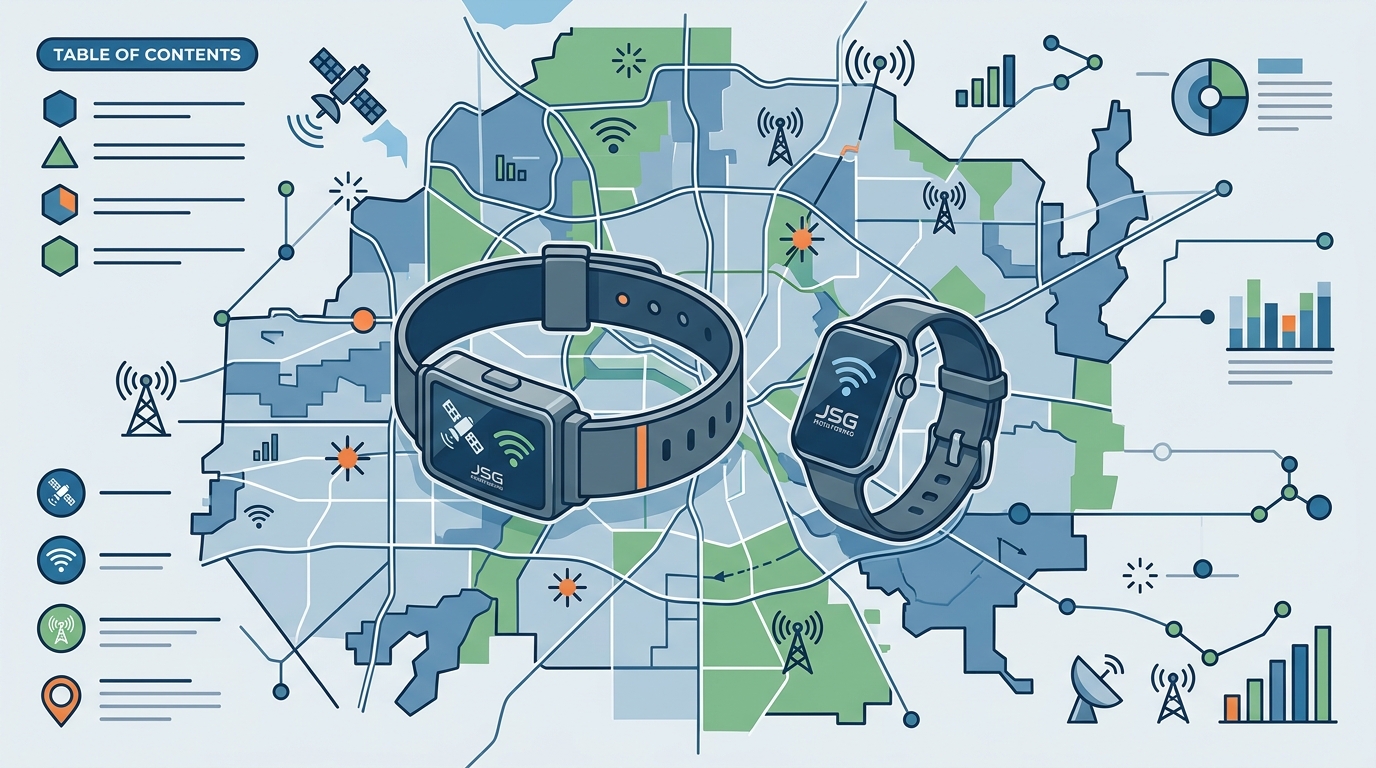
To achieve complete coverage in Dallas, devices must rely on a hybrid approach. Modern monitoring hardware combines GPS with Wi-Fi and cellular triangulation. When GPS signals are weak, the device switches to Wi-Fi access points or cellular towers to determine location. This redundancy ensures that the monitoring agency receives continuous data, even in the heart of downtown Dallas or inside multi-story residential complexes. JSG Monitoring emphasizes this multi-technology integration as a core requirement for reliable urban offender management.
Indoor and GPS-Impaired Environments
Many offenders reside in apartments or work in buildings where GPS signals do not penetrate. Devices equipped with Wi-Fi beacons can identify nearby access points to estimate location. Furthermore, cellular technology provides a fallback mechanism when both GPS and Wi-Fi are unavailable. This layered approach is critical for maintaining compliance and public safety in metropolitan areas like Dallas, where infrastructure density is high. according to Texas Manual on
Cellular Carrier Coverage
Cellular connectivity is the backbone of real-time data transmission for electronic monitoring devices. In Dallas, major carriers provide extensive 4G LTE and 5G coverage, but gaps can still exist in rural outskirts or specific indoor locations. The choice of cellular carrier directly impacts the reliability of the monitoring system. A device connected to a carrier with robust infrastructure in the Dallas-Fort Worth metroplex will transmit location data more consistently than one relying on a carrier with weaker local presence.
Network Redundancy and Connectivity
Advanced monitoring devices often support multiple cellular bands to ensure connectivity. If one frequency band is congested or unavailable, the device can switch to another. This feature is particularly important during peak usage times in urban centers. JSG Monitoring partners with providers who ensure their devices are optimized for the specific cellular networks operating in Texas. This optimization minimizes downtime and ensures that alerts for zone breaches or tampering are delivered instantly to monitoring officers.
Impact on Data Latency
Strong cellular coverage reduces data latency, which is the time it takes for location data to reach the monitoring platform. In high-stakes situations, such as a curfew violation, low latency is essential. Devices that maintain a stable cellular connection in Dallas allow for near real-time visualization of offender movements. This capability supports proactive intervention and enhances the overall effectiveness of community supervision programs.
GPS Satellite Coverage
GPS satellite coverage is generally global, but local conditions determine the quality of the signal. In Dallas, the number of visible satellites can vary based on time of day, weather, and physical obstructions. Standard GPS devices require a minimum number of satellites to calculate a precise location. However, in urban canyons, the number of visible satellites may drop below this threshold, resulting in inaccurate or missing data points. according to University of Texas
Signal Strength and Accuracy
High-quality GPS receivers in modern monitoring devices are designed to lock onto weaker signals more effectively. These receivers use advanced algorithms to filter out noise and improve accuracy. In Dallas, where buildings can reflect GPS signals, causing multipath errors, these advanced receivers are crucial. They help distinguish between direct satellite signals and reflected ones, ensuring that the location data provided to monitoring agencies is as accurate as possible.
Continuous Tracking Capabilities
For complete coverage, devices must maintain a continuous lock on satellites whenever possible. This is achieved through high-sensitivity receivers that can acquire signals quickly after losing them. In the Dallas metroplex, where offenders may move between different types of environments, the ability to re-acquire GPS signals rapidly is vital. JSG Monitoring selects devices that excel in this area, ensuring that tracking remains uninterrupted even as the wearer moves through varying urban landscapes.
GPS Device Brands
Selecting the right GPS device brand is critical for ensuring complete coverage in Dallas. Different brands offer varying levels of technology integration, durability, and software compatibility. JSG Monitoring offers a curated selection of premier electronic monitoring technologies, focusing on devices that provide precise location tracking and tamper-resistant designs. The following table compares key features of devices available through JSG Monitoring that are suitable for the Dallas environment.
| Device Brand/Model | Key Technologies | Urban Coverage Features | Best For |
|---|---|---|---|
| BI LOC8 XT | GPS, Wi-Fi, Cellular | Complete community coverage, GPS interference mitigation | Urban and rural monitoring |
| Omnilink GPS | GPS, Cellular, RF, Wi-Fi Beacons | Precise indoor location verification, two-way communication | High-security cases, indoor tracking |
| SCRAM GPS | GPS, 3G, Google Street View | High accuracy, tamper-proof strap, visual context | Comprehensive offender management |
| BI VeriWatch | GPS, Secure OS | Discreet wrist-worn design, real-time monitoring | Low-profile supervision |
BI LOC8 XT: The All-Rounder
The BI LOC8 XT is a low-profile ankle bracelet that uses GPS, Wi-Fi, and cellular technology to ensure complete community coverage. Its ability to track accurately even during GPS interference makes it an ideal choice for Dallas. The device features robust tamper detection and over-the-air updates, ensuring it remains up to date without physical servicing. This versatility allows monitoring agencies to manage diverse offender populations effectively.
Omnilink GPS: Indoor Precision
The Omnilink GPS OM500 offers precise indoor location verification through optional RF and Wi-Fi beacons. This is particularly useful in Dallas, where many offenders reside in apartments or work in buildings with poor GPS reception. The device integrates seamlessly with FocalPoint software, allowing authorities to visualize and monitor movements in real time. Its tamper-proof design and long battery life further enhance its reliability for continuous monitoring.
SCRAM GPS: Visual Context
The SCRAM GPS provides unmatched location accuracy and integrates with Google Street View mapping. This feature allows officers to visualize the offender's location in a clear, actionable context, which is invaluable in a complex urban environment like Dallas. The device's industry-leading battery life and tamper-proof strap reduce administrative burdens and ensure consistent data collection. It is a comprehensive solution for agencies seeking high-fidelity monitoring data.
Satellite Positioning Reliability
Satellite positioning reliability is determined by the consistency and accuracy of the location data provided by the device. In Dallas, reliability is not just about having a signal, but about the quality of that signal over time. Devices that provide consistent, accurate data points allow monitoring officers to make informed decisions about offender compliance. Unreliable data can lead to false positives, eroding trust in the monitoring system and wasting valuable resources.
Consistency and Data Integrity
Reliable satellite positioning requires devices that maintain data integrity under various conditions. This includes resistance to environmental factors such as rain, heat, and physical impact. JSG Monitoring selects devices that are built for durability and reliability, ensuring they perform consistently in the Texas climate. The devices feature waterproof and submersible designs, protecting the internal components from damage and ensuring continuous operation.
Software Integration and Analytics
The reliability of satellite positioning is also enhanced by the software platform used to process the data. Advanced analytics tools can filter out noise and identify patterns in offender movement. For example, GPS Analytics can provide detailed insights into client movements, helping officers to interpret data efficiently. This integration of hardware and software ensures that the location data is not only accurate but also actionable, supporting effective offender management and public safety.
Key Takeaways
- Urban signal degradation in Dallas requires multi-technology devices combining GPS, Wi-Fi, and cellular data.
- Cellular carrier coverage in the Dallas-Fort Worth metroplex is extensive, but device optimization is crucial for reliability.
- GPS satellite coverage is global, but local obstructions necessitate high-sensitivity receivers for accurate tracking.
- The BI LOC8 XT offers complete community coverage with robust tamper detection and over-the-air updates.
- The Omnilink GPS provides precise indoor location verification, ideal for urban residential areas.
- The SCRAM GPS integrates with Google Street View for visual context, enhancing decision-making for officers.
- Satellite positioning reliability depends on hardware durability and advanced software analytics.
- JSG Monitoring provides tailored equipment solutions and training to support monitoring companies in Texas.
Frequently Asked Questions
What is the best GPS device for monitoring in Dallas?
The best GPS device for monitoring in Dallas is one that utilizes multi-technology integration, such as the BI LOC8 XT or Omnilink GPS. These devices combine GPS, Wi-Fi, and cellular data to overcome urban signal degradation and provide complete coverage.
How does urban signal degradation affect GPS tracking?
Urban signal degradation, caused by tall buildings and concrete structures, blocks direct line-of-sight to satellites. This can lead to inaccurate or missing data for standard GPS-only devices, necessitating the use of multi-technology solutions.
Why is cellular carrier coverage important for electronic monitoring?
Cellular carrier coverage is essential for real-time data transmission. In Dallas, robust carrier coverage ensures that location data is transmitted consistently, minimizing downtime and allowing for near real-time monitoring.
Can GPS devices track offenders indoors in Dallas?
What is the role of Wi-Fi in GPS monitoring devices?
Wi-Fi serves as a fallback mechanism when GPS signals are weak. By identifying nearby access points, the device can estimate location, ensuring continuous tracking in urban environments with poor GPS reception.
How does JSG Monitoring support monitoring companies in Texas?
JSG Monitoring supports monitoring companies by providing cutting-edge products, customized support, and white-label solutions. They offer training, troubleshooting, and 24/7 technical support to ensure seamless services for their partners.
What is satellite positioning reliability?
Satellite positioning reliability is the consistency and accuracy of location data provided by a GPS device over time. It is determined by the quality of the signal, hardware durability, and software analytics.
Do GPS devices in Dallas require frequent maintenance?
Modern GPS devices, such as the BI LOC8 XT, feature over-the-air updates, reducing the need for physical servicing. This minimizes downtime and operational costs, ensuring reliable performance for monitoring agencies.
Conclusion
Achieving complete GPS coverage in Dallas, Texas, requires more than just a standard tracker. It demands a sophisticated approach that integrates multiple technologies to overcome the challenges of urban environments. JSG Monitoring provides the expertise and hardware necessary to ensure reliable, accurate, and continuous monitoring. By partnering with JSG Monitoring, agencies and monitoring companies can access the best electronic monitoring solutions tailored to the specific needs of their programs. To explore how these solutions can enhance your community supervision efforts, today. according to University of Texas