

Modern electronic monitoring hardware uses Wi-Fi and cellular technology to provide accurate, real-time tracking for community supervision programs. JSG Monitoring supplies these advanced devices to courts and law enforcement agencies. This guide covers the specific hardware types, indoor positioning capabilities, and bracelet designs that utilize these connectivity standards to ensure reliable location data.
Ankle Monitor Technology
Ankle monitor technology is a category of electronic devices worn on the lower leg to track an individual's location and compliance with court orders. These devices have evolved significantly from early radio frequency systems to modern multi-network units. The core function of these monitors is to transmit location data to a central server for review by supervising officers.
Multi-Network Connectivity
Advanced ankle monitors now integrate multiple communication protocols to ensure continuous data transmission. A modern GPS tracking unit integrates several key electronic components to determine and transmit its location and other data, as noted in technical documentation of the hardware. By combining GPS, Wi-Fi, and cellular technology, these devices can maintain a connection even when one signal is weak or unavailable.
Cellular networks are the most common method for transmitting data in fleet and tracking systems, utilizing 4G and 5G networks to send information to the cloud. This redundancy is critical for public safety. If a GPS signal is blocked by a building or terrain, the device can switch to Wi-Fi or cellular data to report its status. This ensures that the monitoring agency receives timely alerts regarding zone violations or tampering attempts.
Real-Time Data Transmission
Indoor Positioning Systems
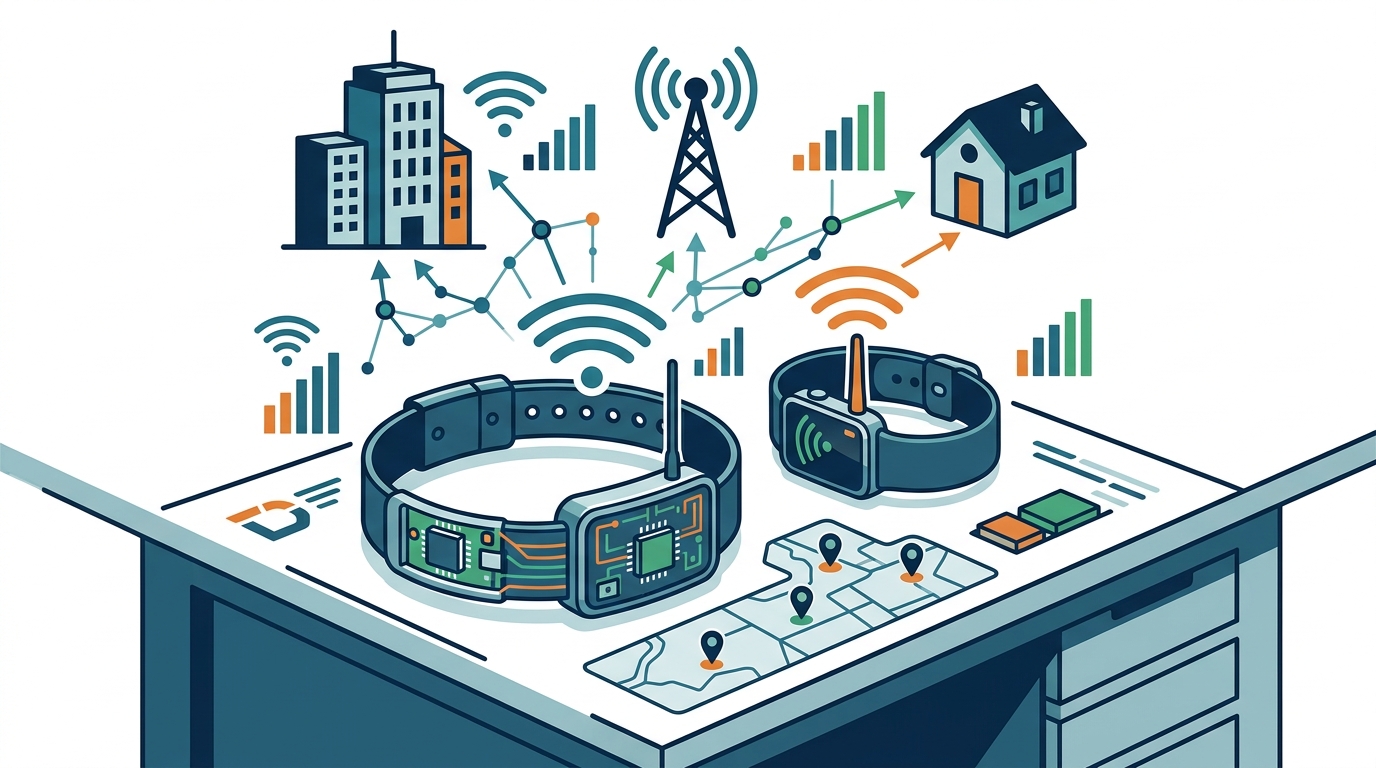
Indoor positioning systems are technologies that determine the location of a device inside a building where GPS signals are often degraded or blocked. GPS satellites transmit signals that struggle to penetrate thick walls and roofs. Therefore, relying solely on GPS can result in significant location errors or complete signal loss indoors. To solve this, modern monitoring hardware incorporates Wi-Fi and cellular triangulation.
Wi-Fi Triangulation
Wi-Fi triangulation is a method that uses the signal strength of nearby wireless access points to estimate a device's position. The device scans for available Wi-Fi networks and measures the signal strength of each. This data is transmitted to a server that compares it against a database of known access point locations. By analyzing the relative strength of multiple signals, the system can estimate the device's location within a building or dense urban area. according to Wi Fi
This technology is particularly useful for verifying if a client is at home during a curfew. Even if the GPS signal is weak inside the house, the device can detect the home Wi-Fi network. This provides a reliable confirmation of presence. The BI LOC8 XT and other advanced units leverage this capability to ensure accurate tracking in GPS-impaired environments.
Cellular Tower Triangulation
Cellular tower triangulation is another technique used to locate devices when GPS is unavailable. The device connects to nearby cellular towers, and the system calculates the location based on the signal strength and timing of the connection to these towers. While less precise than GPS in open areas, this method provides a reasonable estimate of location indoors or in urban canyons. The combination of Wi-Fi and cellular data creates a robust indoor positioning system that minimizes blind spots in monitoring coverage.
Ankle Bracelet Hardware
Ankle bracelet hardware refers to the physical casing, sensors, and straps that house the electronic components of a monitoring device. The design of this hardware is critical for both functionality and user compliance. Modern bracelets are designed to be low-profile and discreet, reducing the stigma associated with wearing a monitor. They are also built to be tamper-resistant to prevent removal or interference with the tracking signals.
Discreet and Low-Profile Designs
Many agencies prefer hardware that is less obtrusive for clients. The BI LOC8 XT is a low-profile, discreet ankle bracelet designed for reliable offender monitoring. Its form-fitting design ensures comfort for the wearer while maintaining robust functionality. Similarly, the BI VeriWatch is a wrist-worn device comparable in size to a consumer smartwatch. This shift towards smaller, more consumer-like hardware helps improve client compliance and reduces the likelihood of tampering due to discomfort or embarrassment.
Tamper Detection and Durability
Durability and tamper detection are essential features of ankle bracelet hardware. The devices are built to withstand daily wear and tear, including exposure to water and physical impact. They feature robust tamper detection systems that alert the monitoring center if the strap is cut or the device is removed. The OM500, for example, features a cut-free, fiber optic strap that prevents false tamper alerts. This reliability is crucial for maintaining the integrity of the monitoring data and ensuring that alerts are actionable.
Battery Life and Power Management
Battery life is a key consideration in the hardware design of ankle bracelets. Continuous transmission of GPS, Wi-Fi, and cellular data consumes significant power. Modern devices feature long-life batteries and power-saving options to extend operational time between charges. The BI LOC8 XT includes a power-saving beacon option that enhances battery life. This ensures that the device remains active and connected for extended periods, reducing the need for frequent recharging and minimizing the risk of monitoring gaps.
| Device Model | Form Factor | Connectivity Technologies | Key Features |
|---|---|---|---|
| BI LOC8 XT | Ankle Bracelet | GPS, Wi-Fi, Cellular | Low-profile, tamper detection, Google Maps integration |
| Omnilink GPS (OM500) | Ankle Monitor | GPS, Cellular, RF, Wi-Fi Beacons | Two-way communication, waterproof, fiber optic strap |
| SCRAM GPS | Ankle Bracelet | GPS, 3G Cellular | Tamper-proof strap, GPS Analytics, Street View mapping |
| BI VeriWatch | Wrist-Worn | GPS, Wi-Fi, LTE Cellular | Smartwatch size, biometric facial comparison, liveness detection |
Key Takeaways
- Modern monitoring hardware uses a combination of GPS, Wi-Fi, and cellular technology to ensure reliable tracking.
- Wi-Fi and cellular triangulation enable accurate indoor positioning when GPS signals are blocked.
- Low-profile and discreet hardware designs improve client comfort and compliance.
- Tamper-resistant straps and robust detection systems are critical for data integrity.
- Long battery life and power-saving modes are essential for continuous monitoring.
- Real-time data transmission allows officers to visualize client movements on mapping platforms.
- Wrist-worn devices offer a discreet alternative to traditional ankle bracelets.
- Choosing the right hardware depends on the specific needs of the monitoring program and the risk level of the client.
Frequently Asked Questions
What is the difference between GPS and Wi-Fi tracking?
GPS tracking uses satellite signals to determine location, which is highly accurate outdoors. Wi-Fi tracking uses the signal strength of nearby wireless networks to estimate location, which is more effective indoors where GPS signals are weak. according to GPS tracking unit
Can monitoring devices track clients inside a house?
Yes, devices that use Wi-Fi and cellular triangulation can track clients indoors. They detect nearby Wi-Fi networks and cellular towers to estimate the device's position within a building. according to Vehicle tracking system
What is a low-profile ankle bracelet?
A low-profile ankle bracelet is a monitoring device designed to be slim and discreet, resembling consumer electronics. This design aims to reduce the stigma and discomfort associated with wearing a monitor.
How does tamper detection work in monitoring hardware?
Tamper detection systems use sensors in the strap and device casing to detect cuts, removal, or interference. When tampering is detected, the device sends an immediate alert to the monitoring center.
Why is cellular connectivity important for monitoring?
Cellular connectivity allows the device to transmit data to the monitoring server in real-time. It provides a backup to GPS and Wi-Fi, ensuring that the device remains connected even in areas with poor signal coverage.
What is the benefit of using Wi-Fi for indoor positioning?
Wi-Fi provides a reliable method for determining a device's location indoors, where GPS signals are often blocked by walls and roofs. This ensures that monitoring coverage is continuous and accurate.
Are wrist-worn devices as reliable as ankle bracelets?
Wrist-worn devices like the BI VeriWatch use the same core technologies as ankle bracelets, including GPS and cellular connectivity. They offer a discreet alternative while maintaining reliable tracking capabilities.
Conclusion
Selecting the right monitoring hardware is critical for the success of community supervision programs. By utilizing Wi-Fi and cellular technology alongside GPS, modern devices provide accurate and reliable tracking in both indoor and outdoor environments. JSG Monitoring offers a comprehensive range of these advanced solutions, ensuring that agencies have access to the best technology available. To explore how these hardware solutions can enhance your monitoring program, .