
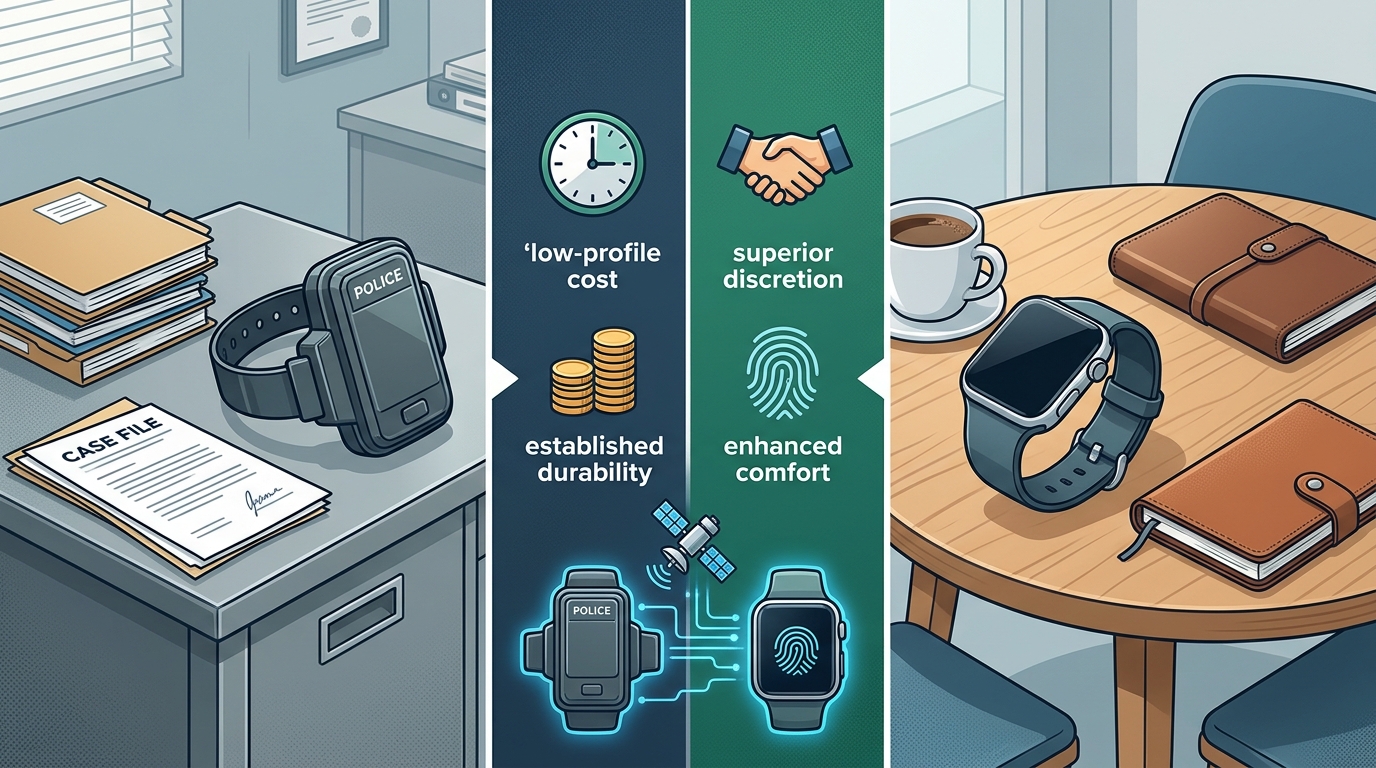
For probation programs in 2026, wrist-worn devices offer superior discretion and comfort, while ankle monitors provide established durability and lower cost. Choose wrist-worn devices for high-profile offenders or those requiring long-term supervision to reduce stigma. Choose ankle monitors for standard caseloads where budget constraints and proven tamper-evidence are the primary priorities. JSG Monitoring provides both options to help agencies match the right technology to specific offender risk profiles.
Ankle Monitors: The Established Standard
Ankle monitor is a GPS-enabled bracelet worn on the ankle that provides continuous location tracking and tamper alerts. This technology has been the backbone of electronic monitoring for decades. Agencies rely on ankle devices because they are difficult to remove without triggering an alarm. The hardware is generally robust and designed to withstand daily wear and tear in various environments.
Strengths
Limits
The main drawback is visibility. Ankle monitors are bulky and difficult to hide. This can lead to social stigma for the wearer, which may impact their ability to maintain employment or social stability. The physical discomfort can also lead to skin irritation over long periods. For some offenders, the visible nature of the device can feel punitive rather than rehabilitative.
Who It Suits
Ankle monitors are best suited for standard probation cases where cost efficiency is a major factor. They are ideal for agencies managing large caseloads with limited budgets. The technology is also preferred for offenders who do not have specific concerns about public visibility or who are in the early stages of supervision where strict compliance is the primary goal.
Wrist-Worn Devices: The Discreet Alternative
A wrist-worn tracking device is a compact, smartwatch-like unit that uses GPS and cellular technology to monitor offender location. These devices are designed to look like consumer electronics, offering a level of discretion that ankle monitors cannot match. JSG Monitoring offers the BI VeriWatch, a discreet wrist-worn device that runs on a secure, custom operating system designed for the rigors of community supervision.
Strengths
Discretion is the defining feature of wrist-worn technology. Because the device resembles a standard smartwatch, it reduces the social stigma associated with electronic monitoring. This can help offenders maintain dignity and focus on rehabilitation. The devices are also lighter and more comfortable to wear for extended periods. Many models feature biometric facial comparison to confirm client identity, adding a layer of security that complements the physical device.
Limits
Battery life is a common limitation for wrist-worn devices. Due to their smaller form factor, they often require more frequent charging than ankle monitors. Some models offer up to 16 hours of battery life on a single charge, which may require daily charging routines. Additionally, the smaller size can make tamper detection slightly more complex, though modern devices use proximity sensors and liveness detection to mitigate this risk.
Who It Suits
Feature Comparison Table
| Criteria | Ankle Monitors | Wrist-Worn Devices |
|---|---|---|
| Visibility | High (Bulky and obvious) | Low (Resembles smartwatch) |
| Battery Life | Longer (Often 24+ hours) | Shorter (Often 12-16 hours) |
| Comfort | Moderate (Can cause irritation) | High (Lightweight and form-fitting) |
| Tamper Evidence | High (Mature cut-detection) | High (Proximity and biometric checks) |
| Cost | Lower | Higher |
| Best For | Standard caseloads, budget focus | High-profile cases, long-term supervision |
Decision Guidance for Agencies
Selecting the right monitoring technology requires balancing security, cost, and offender outcomes. Agencies should consider the specific needs of their caseload when making this decision.
Choose Ankle Monitors If
Select ankle monitors if your agency is managing a large volume of standard probation cases with limited budget. This option is also appropriate if your jurisdiction has strict mandates for visible compliance indicators. Ankle devices are a proven, cost-effective solution for ensuring basic location tracking and curfew enforcement.
Choose Wrist-Worn Devices If
Select wrist-worn devices if you are supervising high-profile individuals, professionals, or those in sensitive social situations. This option is also ideal if your agency aims to reduce stigma and support rehabilitation through dignity-preserving supervision. Wrist-worn technology is a strategic choice for agencies looking to modernize their approach to community corrections.
For agencies seeking a hybrid approach, JSG Monitoring offers a comprehensive product lineup that includes both ankle and wrist-worn options. This allows for flexible deployment based on individual offender risk assessments. To explore how these solutions can fit your program, view our product catalog.
Frequently Asked Questions
Can agencies switch from ankle to wrist-worn devices mid-program?
Yes, agencies can switch devices mid-program. However, this requires coordination with the monitoring provider to ensure data continuity. JSG Monitoring supports seamless transitions between device types to maintain uninterrupted supervision.
Are wrist-worn devices as secure as ankle monitors?
Wrist-worn devices use advanced security features like biometric facial comparison and liveness detection. While the form factor is different, the security protocols are designed to meet the same high standards as ankle monitors. The key is ensuring the device is properly fitted and monitored for removal attempts.
What is the main cost difference between the two?
Wrist-worn devices typically have a higher upfront hardware cost than ankle monitors. However, the long-term benefits of reduced stigma and improved offender outcomes may offset this difference. Agencies should evaluate total cost of ownership, including maintenance and support.
Do wrist-worn devices require more frequent charging?
Yes, due to their smaller size, wrist-worn devices often have shorter battery life. Most models require charging every 12 to 16 hours. Agencies should educate offenders on proper charging routines to ensure compliance.
How does JSG Monitoring support agencies in choosing the right device?
JSG Monitoring provides expert guidance and tailored solutions to help agencies select the best technology for their specific needs. Our team works closely with courts and law enforcement to design effective monitoring programs. To discuss your agency's requirements, .