

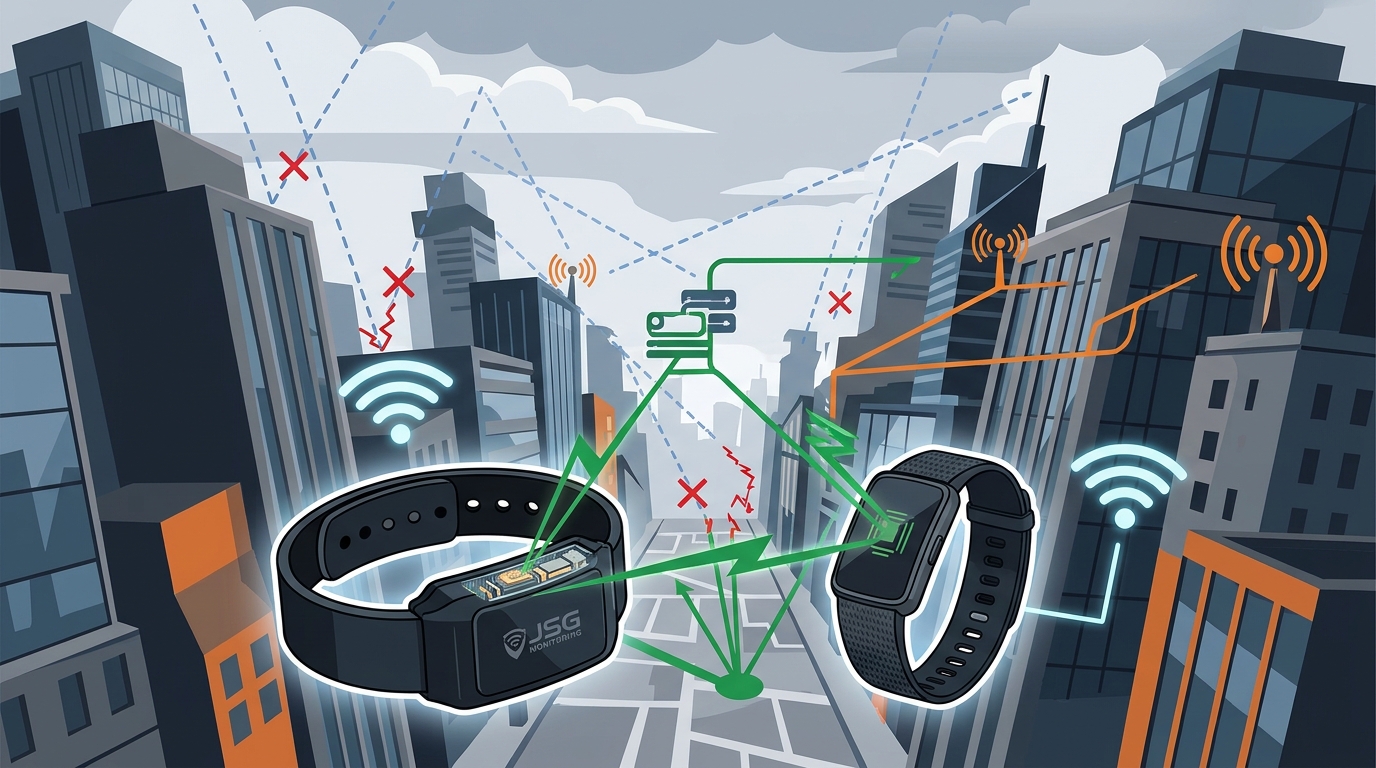
GPS monitoring devices handle weak signals in dense urban areas by utilizing multi-technology triangulation, specifically combining GPS with Wi-Fi and cellular data. This hybrid approach ensures continuous location tracking even when satellite signals are blocked by tall buildings or poor weather. For pretrial supervision, this redundancy is critical to maintaining compliance without false alarms. JSG Monitoring provides equipment designed to navigate these complex urban environments effectively.
The Physics of Urban Signal Loss
Urban canyons create significant challenges for satellite-based navigation. Tall structures block the direct line of sight between the GPS satellite and the receiver on the ankle or wrist. This phenomenon, known as multipath interference, causes signals to bounce off surfaces, leading to inaccurate location data. In pretrial supervision, accurate location is the primary evidence of compliance. When a device loses its satellite lock, the system must rely on alternative data sources to maintain a reliable trail.
GPS signal degradation is a common occurrence in metropolitan centers. The density of buildings and infrastructure creates a complex electromagnetic environment. Standard GPS units may struggle to acquire a fix in these areas. This is why modern monitoring devices are engineered with redundant systems. They do not rely on a single source of truth. Instead, they aggregate data from multiple networks to provide a consistent location history.
Multi-Technology Triangulation Methods
Modern electronic monitoring devices use a combination of GPS, Wi-Fi, and cellular technology to overcome signal loss. Wi-Fi triangulation uses the signal strength of nearby access points to estimate location. Cellular triangulation uses the proximity to cell towers. By cross-referencing these data points with any available GPS fix, the device can maintain accuracy. This method is essential for pretrial defendants who may be in areas with poor satellite coverage.
The BI LOC8 XT is a prime example of this technology. It uses GPS, Wi-Fi, and cellular technology to ensure complete community coverage. This device is designed to track accurately even during GPS interference. The integration of these technologies allows for a seamless transition between data sources. When the GPS signal weakens, the device automatically shifts to Wi-Fi or cellular data. This ensures that the monitoring agency receives continuous updates without gaps in the record.
Indoor and Suburban Tracking Capabilities
Pretrial supervision often involves curfews or exclusion zones that require precise indoor tracking. GPS signals do not penetrate buildings well. To address this, devices like the Omnilink GPS OM500 use optional RF and Wi-Fi Beacons. These beacons are installed in specific locations, such as the defendant's home. The device communicates with these beacons to verify indoor presence. This provides precise tracking in environments where GPS is unavailable.
The ability to track indoors is a significant advantage for pretrial programs. It allows for the enforcement of house arrest conditions with high precision. The OM500 is designed for durability and reliability in these scenarios. It features a tamper-proof design and long battery life. This ensures that the device remains functional and secure throughout the supervision period. The combination of outdoor GPS and indoor beacon technology creates a comprehensive monitoring solution.
Impact on Pretrial Compliance and Reporting
Signal degradation can lead to false alarms if not handled correctly. A sudden loss of GPS signal might be interpreted as a tamper event or a violation. However, advanced devices distinguish between signal loss and actual tampering. They use robust tamper detection features to alert authorities only when necessary. This reduces the administrative burden on monitoring officers. It also prevents unnecessary court appearances for defendants who are in compliance.
Accurate reporting is vital for pretrial supervision. Monitoring agencies rely on detailed compliance reports to make decisions. Devices that provide clear data on signal quality and location accuracy help agencies make informed judgments. The SCRAM GPS, for example, integrates with the SCRAM Systems platform to provide detailed insights. It uses GPS Analytics and Google Street View mapping to put locations into context. This helps officers visualize and interpret data efficiently. The result is a more effective and fair supervision process.
Key Takeaways
- GPS signal degradation is a common issue in dense urban areas due to multipath interference.
- Modern devices use multi-technology triangulation, combining GPS, Wi-Fi, and cellular data.
- The BI LOC8 XT provides complete community coverage by leveraging multiple signal sources.
- Indoor tracking is achieved through the use of RF and Wi-Fi Beacons, as seen in the Omnilink GPS.
- Advanced tamper detection helps distinguish between signal loss and actual violations.
- Accurate data and clear reporting are essential for effective pretrial supervision.
Frequently Asked Questions
How do GPS devices work in areas with no satellite signal?
They switch to Wi-Fi and cellular triangulation to estimate location based on nearby network infrastructure.
What is multipath interference in GPS monitoring?
Multipath interference is the distortion of GPS signals caused by reflections off buildings and other surfaces.
Can electronic monitoring devices track indoors?
Yes, they can use installed beacons or Wi-Fi signals to verify presence inside a building.
Does signal loss count as a violation?
No, signal loss is generally not a violation unless it is accompanied by tamper alerts or zone breaches.
Which devices are best for urban environments?
Devices with multi-technology support, such as the BI LOC8 XT, are best for urban environments.
Conclusion
Handling weak signals in dense urban areas is a critical aspect of modern electronic monitoring. By leveraging multi-technology triangulation and indoor beacons, devices ensure continuous and accurate tracking. JSG Monitoring offers a range of solutions, including the BI LOC8 XT and Omnilink GPS, designed to meet these challenges. To learn more about how these technologies can support your pretrial supervision program, .