
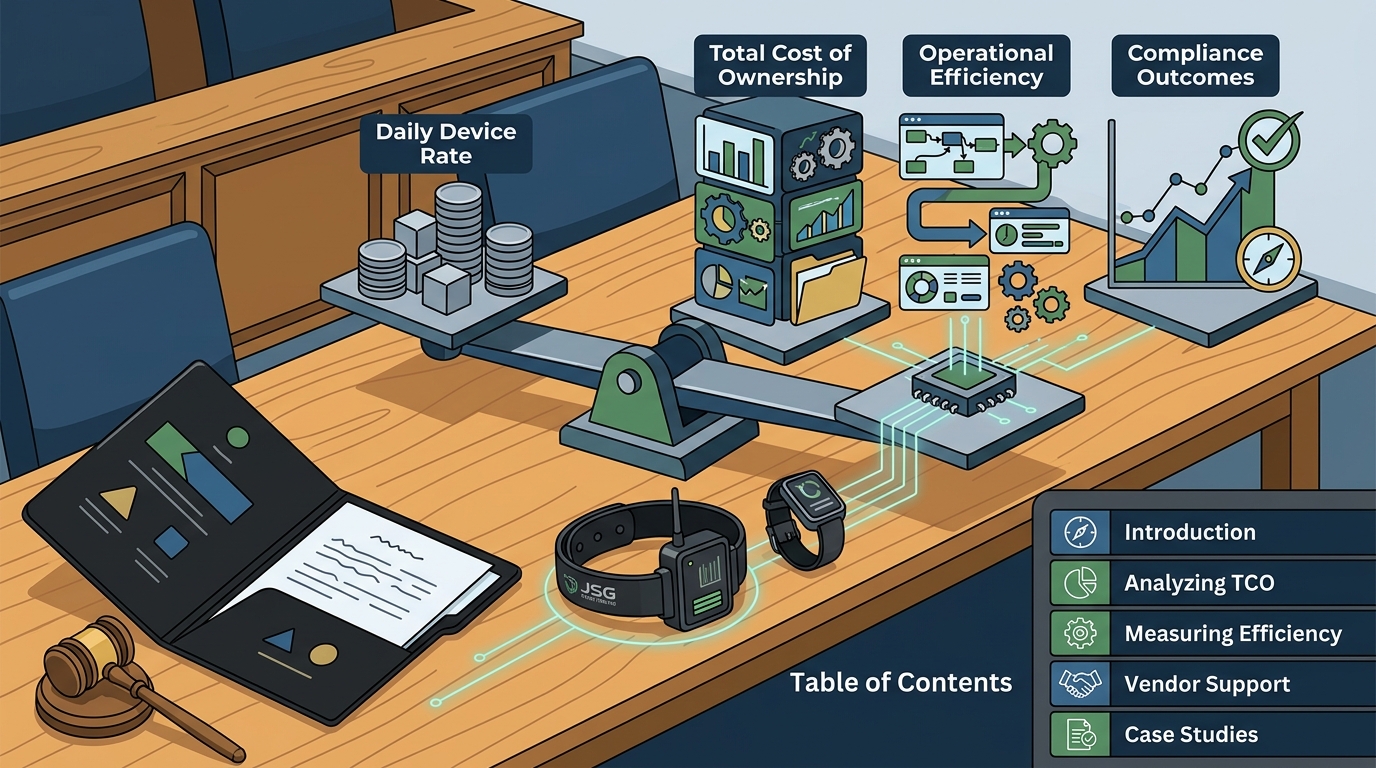
Courts evaluate monitoring vendor pricing by analyzing total cost of ownership, operational efficiency, and compliance outcomes rather than just the daily device rate. JSG Monitoring supports this evaluation by providing transparent, technology-driven solutions that reduce administrative burdens and enhance public safety. This approach ensures that public funds deliver measurable results in community supervision programs.
Understanding Total Cost of Ownership
When a court selects a vendor, they are not just buying a bracelet; they are buying a service ecosystem. This includes the cost of installation, maintenance, and the software platform used to track offenders. If a device requires frequent physical servicing, the labor costs for court staff can quickly outweigh the savings from a lower daily rate. JSG Monitoring emphasizes that reliable technology reduces these hidden costs by minimizing downtime and false alerts.
For example, a device with a long battery life and over-the-air update capabilities reduces the need for staff to visit offenders for routine maintenance. This operational efficiency is a critical factor in determining true value. By focusing on total cost of ownership, courts can make more informed decisions that protect taxpayer dollars.
Operational Efficiency and Staff Workload
Operational efficiency is a key metric in evaluating vendor pricing because it directly impacts staff productivity. A monitoring system that generates excessive false alarms or requires manual data entry consumes valuable court resources. These hidden labor costs can significantly increase the effective price of monitoring services.
Modern electronic monitoring solutions, such as those offered by JSG Monitoring, are designed to streamline workflows. Features like automated facial recognition and real-time data transmission reduce the need for manual verification. This allows probation officers to focus on higher-priority cases rather than administrative tasks. The implication is that a slightly higher upfront cost for a more efficient system can result in long-term savings.
Consider a scenario where a court uses a legacy system that requires officers to manually review photos for every test. This process is time-consuming and prone to error. In contrast, a system with automated bio-confirmation reduces this workload dramatically. By evaluating how a vendor’s technology impacts staff workload, courts can better assess the true value of their investment.
Compliance Outcomes and Recidivism Reduction
The ultimate measure of value in electronic monitoring is the reduction of recidivism and the enhancement of public safety. Courts must evaluate whether a vendor’s pricing structure aligns with these outcomes. A low-cost solution that fails to keep offenders compliant is not a good value for taxpayers.
Research and industry data suggest that effective monitoring programs can reduce reoffending rates. JSG Monitoring partners with courts to provide tools that support accountability and rehabilitation. By using advanced GPS and alcohol monitoring devices, courts can ensure that offenders adhere to court-ordered conditions. This leads to better outcomes for the community and justifies the investment in monitoring technology. according to Understanding Research Transparency
For instance, a court that implements a comprehensive monitoring program may see a decrease in jail overcrowding. This reduction in incarceration costs can offset the expenses of electronic monitoring. By linking pricing to compliance outcomes, courts can demonstrate to the public that their investment is yielding tangible benefits.
Pricing Transparency and Reporting Standards
Pricing transparency is essential for courts to hold vendors accountable. Vendors should provide clear, itemized pricing that breaks down costs for hardware, software, and services. This transparency allows courts to compare different vendors on a level playing field.
JSG Monitoring is committed to providing clear documentation and reporting standards. Courts need to know exactly what they are paying for and how their data is being used. Transparent pricing structures help prevent unexpected costs and ensure that public funds are used responsibly. This is particularly important in an era where public scrutiny of government spending is high. according to A Price to
Furthermore, vendors should offer flexible pricing models that can adapt to the specific needs of a court. Some courts may require 24/7 monitoring for high-risk offenders, while others may only need intermittent checks for lower-risk individuals. A vendor that offers scalable solutions allows courts to tailor their spending to their risk assessment needs. This flexibility is a key component of fair taxpayer value.
Key Takeaways
- Electronic monitoring pricing is a complex model that includes hardware, software, and labor costs.
- Total cost of ownership is a more accurate metric than the daily device rate.
- Operational efficiency, such as reduced staff workload, is a critical factor in value assessment.
- Compliance outcomes, including recidivism reduction, are the ultimate measure of value.
- Pricing transparency and clear reporting standards are essential for accountability. according to PGI 215 4
- Flexible pricing models allow courts to tailor spending to their specific risk assessment needs.
Frequently Asked Questions
What is the most important factor in evaluating monitoring vendor pricing?
The most important factor is the total cost of ownership, which includes hardware, software, and labor costs, rather than just the daily device rate.
How does operational efficiency impact the value of electronic monitoring?
Operational efficiency reduces staff workload and administrative burdens, which can lead to long-term savings and better use of public resources.
Why is compliance outcome a key metric for taxpayer value?
Compliance outcomes, such as reduced recidivism and jail overcrowding, demonstrate that the investment in monitoring is yielding tangible benefits for the community.
What role does pricing transparency play in vendor selection?
Pricing transparency allows courts to compare vendors on a level playing field and hold them accountable for their costs and services.
How can courts ensure that their monitoring program is cost-effective?
Courts can ensure cost-effectiveness by evaluating total cost of ownership, operational efficiency, and compliance outcomes, and by choosing vendors with transparent pricing and flexible models.