

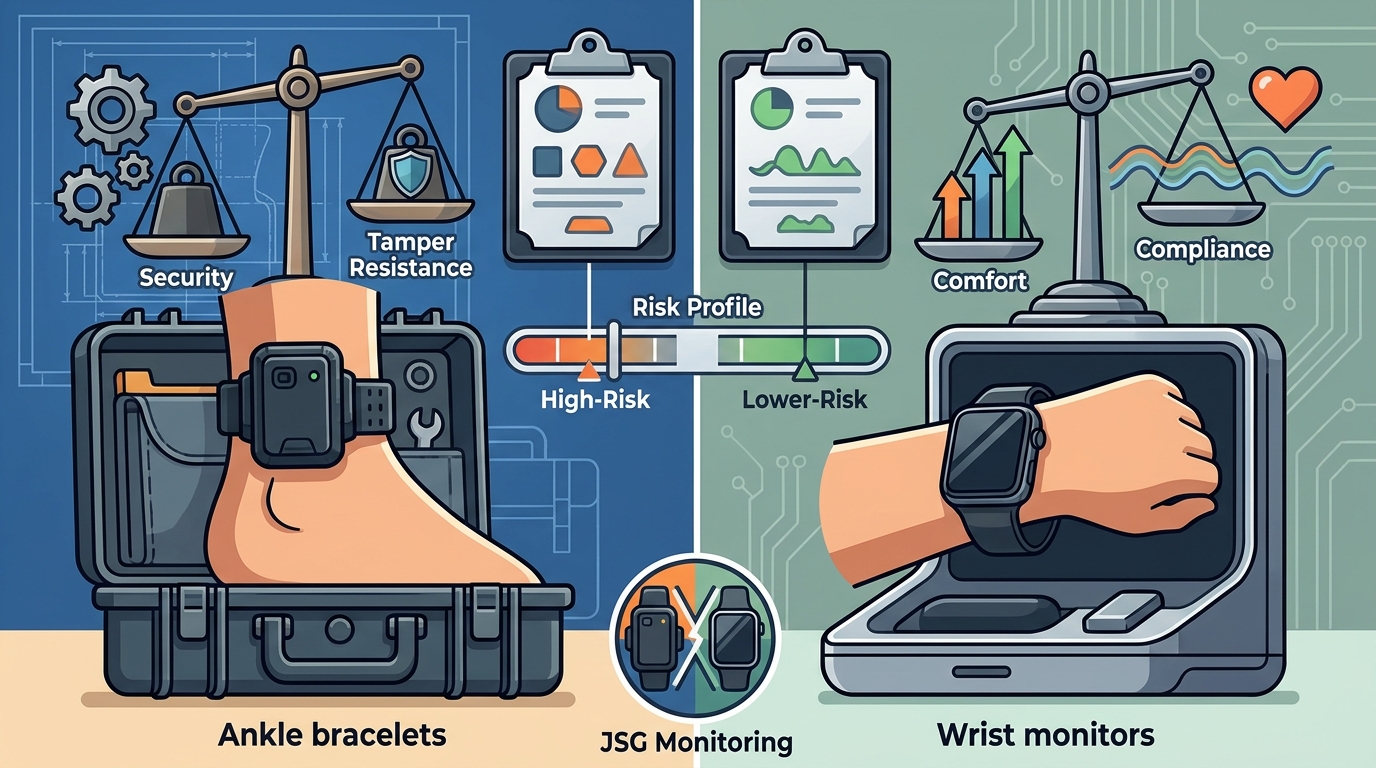
Courts and probation departments generally rate ankle bracelets higher for security and tamper resistance, while wrist monitors earn stronger marks for comfort and compliance. Ankle devices remain the standard for high-risk cases due to their robust construction. Wrist-worn options are gaining traction for lower-risk offenders who require discretion. JSG Monitoring provides both form factors to help agencies match the device to the specific risk profile of the individual.
Security and Tamper Resistance
Security is the primary metric for judicial evaluation. Ankle bracelets are typically constructed with heavy-duty materials and cut-resistant straps. This design makes them significantly harder to remove without triggering an immediate alert. Probation officers often prefer this level of physical security for individuals with a history of non-compliance. The visibility of an ankle device also serves as a constant reminder of supervision. In contrast, wrist monitors are smaller and less conspicuous. While they offer strong security features, their smaller size can make them easier to conceal or remove in certain scenarios. Agencies must weigh the trade-off between physical robustness and the potential for concealment.
Comfort and Daily Compliance
Comfort directly impacts compliance rates. Wrist monitors are comparable in size to consumer smartwatches. This form factor allows individuals to wear them with minimal disruption to daily activities. Many users report that wrist devices are less noticeable and more comfortable during sleep and exercise. Ankle bracelets, while durable, can cause skin irritation or discomfort during prolonged wear. This discomfort can lead to non-compliance or attempts to remove the device. Probation departments note that higher comfort levels often correlate with better long-term adherence to monitoring conditions. JSG Monitoring designs its wrist-worn devices to run on secure operating systems, ensuring that comfort does not compromise data integrity.
Technology and Tracking Accuracy
Both ankle and wrist monitors utilize GPS, Wi-Fi, and cellular technology for tracking. The key difference lies in the sensor placement and battery management. Wrist monitors often feature biometric facial comparison and liveness detection to confirm identity. This technology helps prevent proxy testing or device sharing. Ankle devices rely heavily on location data and tamper sensors. Both form factors offer real-time tracking and zone alerts. However, wrist monitors may require more frequent charging due to their smaller battery capacity. Agencies must consider the operational burden of charging logistics when selecting a device. JSG Monitoring offers devices with cordless charging and extended battery life to mitigate these operational challenges.
Comparison Table: Ankle vs Wrist Monitors
| Criteria | Ankle Bracelets | Wrist Monitors |
|---|---|---|
| Security Level | High (Cut-resistant, robust) | Medium-High (Biometric, secure OS) |
| Comfort | Lower (Bulky, potential irritation) | Higher (Smartwatch-sized, discreet) |
| Visibility | High (Constant reminder) | Low (Discreet, less conspicuous) |
| Battery Life | Longer (Larger battery) | Shorter (Requires frequent charging) |
| Best For | High-risk, strict curfews | Lower-risk, treatment programs |
Choose Ankle Bracelets If
Select ankle bracelets for high-risk offenders or those with strict curfew requirements. These devices offer the highest level of physical security and tamper resistance. They are ideal for individuals who have a history of non-compliance or who pose a significant threat to public safety. The visibility of the device acts as a deterrent and a constant reminder of supervision. JSG Monitoring’s ankle devices feature robust tamper detection and long battery life, making them suitable for extended monitoring periods.
Choose Wrist Monitors If
Select wrist monitors for lower-risk offenders or those in treatment programs. These devices offer greater comfort and discretion, which can improve compliance rates. They are suitable for individuals who need to maintain employment or social activities while under supervision. The biometric features of wrist monitors ensure accurate identity verification. JSG Monitoring’s wrist-worn devices provide reliable real-time monitoring with a form factor that minimizes disruption to daily life.
Frequently Asked Questions
Can courts switch offenders from ankle to wrist monitors?
Yes, courts can switch offenders between device types based on risk assessment. This flexibility allows agencies to adjust supervision levels as the individual’s behavior improves. JSG Monitoring supports seamless transitions between its product lines to ensure continuity of monitoring. according to How Do I
Are wrist monitors as secure as ankle bracelets?
Wrist monitors offer strong security through biometric verification and secure operating systems. While ankle bracelets are physically more robust, wrist monitors provide comparable data integrity and tamper alerts. The choice depends on the specific risk profile of the offender.
How do probation departments handle charging for wrist monitors?
Probation departments typically provide charging stations or require offenders to charge devices at home. JSG Monitoring’s devices feature cordless charging and extended battery life to reduce the frequency of charging. This design minimizes the operational burden on both officers and offenders.
Do wrist monitors work in GPS-impaired environments?
Yes, wrist monitors utilize Wi-Fi and cellular technology to maintain tracking in areas with poor GPS signal. This multi-technology approach ensures complete community coverage. JSG Monitoring’s devices are designed to provide accurate location data even in dense urban or indoor settings.
What is the cost difference between ankle and wrist monitors?
Costs vary by provider and specific model. Generally, wrist monitors may have higher upfront hardware costs due to advanced biometric features. However, their comfort and compliance benefits can reduce long-term administrative costs. JSG Monitoring offers competitive pricing for both form factors.
Conclusion
Courts and probation departments rate ankle bracelets for their superior security and wrist monitors for their comfort and compliance benefits. The right choice depends on the individual’s risk level and specific monitoring needs. JSG Monitoring provides a comprehensive suite of electronic monitoring solutions to support effective community supervision. To discuss the best device for your agency’s needs, .